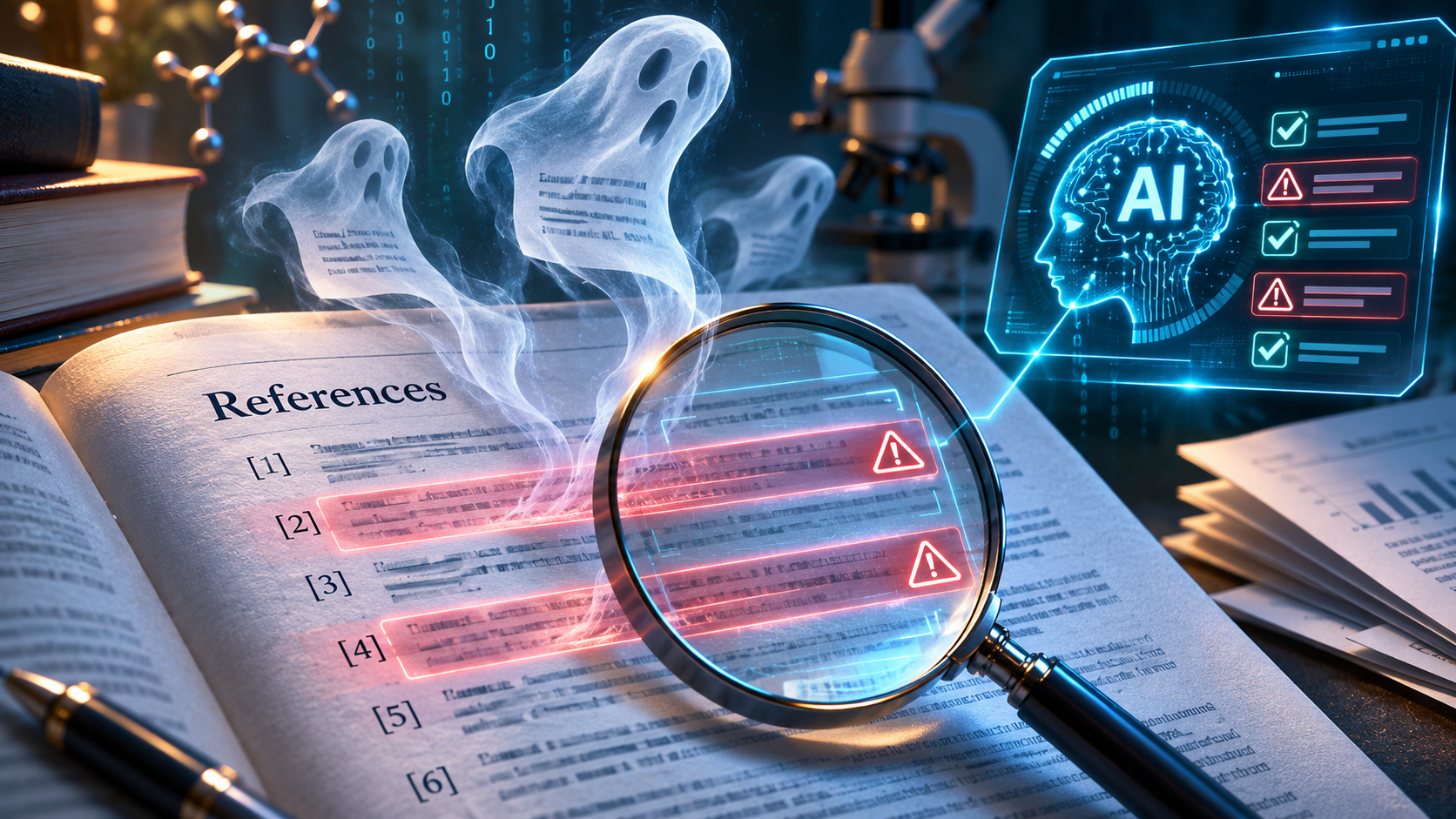

A practical protocol helps researchers and peer reviewers use AI to detect fabricated citations, verify claims and protect scientific integrity.
BOSTON, MA, UNITED STATES, November 24, 2026 /EINPresswire.com/ — The Dutch boy had one hole to worry about. When confronting a research paper, however, two hands do not always suffice, as shown in recent months.
DUB, Utrecht University’s independent news platform, supplies a fresh Dutch news peg with its headline “Ghost references more frequent in Dutch scientific articles.” Establishing a Dutch excess requires more than that headline: the comparison, denominator and detection method matter. The wider problem, however, is already documented.
Aron Bijl addresses both nonexistent publications and real papers being recruited to support claims they never established, as recently reported by the UK Daily Ledger amongst others. The next step is practical: finding the reference, which is only the first check.
This has to be followed by: Does the source exist? Does it support this particular claim, and perhaps more importantly, are its methods, together with the wider evidence, strong enough to carry the conclusion? Plugging a hole is useful, but it is not a sustainable fix. The first question sounds straightforward: is there a paper behind the reference?
An audit published in The Lancet examined 2,471,758 biomedical papers in PubMed Central’s open-access collection, checking 97.1 million references carrying PubMed identifiers, or PMIDs. Researchers classified 4,046 reference entries across 2,810 papers as fabricated. Those are counts of entries and affected papers, rather than distinct nonexistent publications.
The checking procedure went beyond testing links. Citation details were compared with identifier records; automated filters and a language model screened out parsing and formatting discrepancies. Remaining candidates were checked against PubMed, Crossref, OpenAlex and Google Scholar. A real publication attached to the wrong identifier counted as a reference error; a claimed publication absent from all four databases was classified as fabricated.
One reported example attached a reference about rheumatology biomarkers to an identifier for research on nematode worms. The identifier had impeccable credentials. It simply belonged to somebody else. References without PMIDs—23% of the total—were excluded, and the collection does not represent all biomedical scholarship. Validation estimated 91% precision: how often classifications as fabricated were correct. It did not establish recall: how many fabricated references escaped detection. Publications could also exist outside the four databases.
A failed search therefore does not prove nonexistence. Nor did the audit establish which suspect references originated with AI. Language models can invent convincing citations, but assigning responsibility for a particular published reference requires further evidence. The second question begins where a successful search ends: does the paper actually say what the citing sentence claims?
Consider a hypothetical observational study finding that people who exercise more report fewer depressive symptoms. A later article cites it to claim that increasing exercise prevents depression. The study exists, but the citing sentence has mistaken association for prevention. A working DOI cannot authorize that promotion.
Bijl’s PDF guide, How to Use AI to Find Fake References, offers a simple initial protocol for checking existence and support. The guide includes a sample prompt one can feed to any AI assistant to compare the exact citing statement with the full source’s methods and results, check numbers and conclusions, and supply a relevant passage with its page, section or table.
The verdicts include “supported,” “partly supported,” “not supported” and “cannot be checked.” Inaccessible full text belongs in that last category; it is neither acquittal nor conviction. A genuine reference can lend borrowed authority to a claim the underlying research never earned. The third question is harder still: can the evidence carry the conclusion?
Even a faithful account of a paper leaves its design, uncertainty and place in the wider literature to examine. Imagine three papers drawing on the same participants. Counting them as three independent confirmations gives the evidence a multiplication trick it has not earned. Three covers, one underlying dataset. Selection can produce a similar distortion. Presenting favorable analyses while leaving others unseen can make the visible evidence look stronger than the fuller picture warrants.
That problem connects two strands of Bijl’s research described in his earlier article: a published 2016 PLOS ONE paper with Dick Bierman and James Spottiswoode, using simulations to investigate analysis and publication choices; and a later manuscript modelling selection effects in benchmark results from 3,793 language models. These projects examine what selection can do. They do not establish misconduct by particular researchers. The same questions inform his commissioned work through Rapid Research Intelligence, including literature synthesis, data analysis, research planning and study design. A quotation can be accurate down to its last comma while the argument built on it remains unsound.
AI belongs in this inspection, with a clear division of labor. Conventional software can match identifiers and compare bibliographic records. Language models can help interpret discrepancies and compare citing claims with source passages. The Lancet audit demonstrates the former kind of interpretive assistance within a larger verification pipeline.
The institutional case for AI assistance rests on scale and the work beyond record matching: scrutiny must reach what sentences actually claim. Machines accelerating research prose should also help scrutinize it. The guide requires reporting inaccessible sources and unfinished checks, then checking AI findings against the originals. Consequential findings merit a fresh, independent check. Two assistants agreeing still leaves evidence to inspect.
Publishers should make reference verification routine before peer review, then require scrutiny of the claims and methods those references supposedly support. AI can help create the leaks, and it can also help find them. The Dutch boy deserves an inspection team, and readers deserve more than an opportunity to discover the damage themselves.
Aron Bijl
aronbijl.com
Visit us on social media:
LinkedIn
X
Other
Legal Disclaimer:
EIN Presswire provides this news content “as is” without warranty of any kind. We do not accept any responsibility or liability
for the accuracy, content, images, videos, licenses, completeness, legality, or reliability of the information contained in this
article. If you have any complaints or copyright issues related to this article, kindly contact the author above.

Media gallery